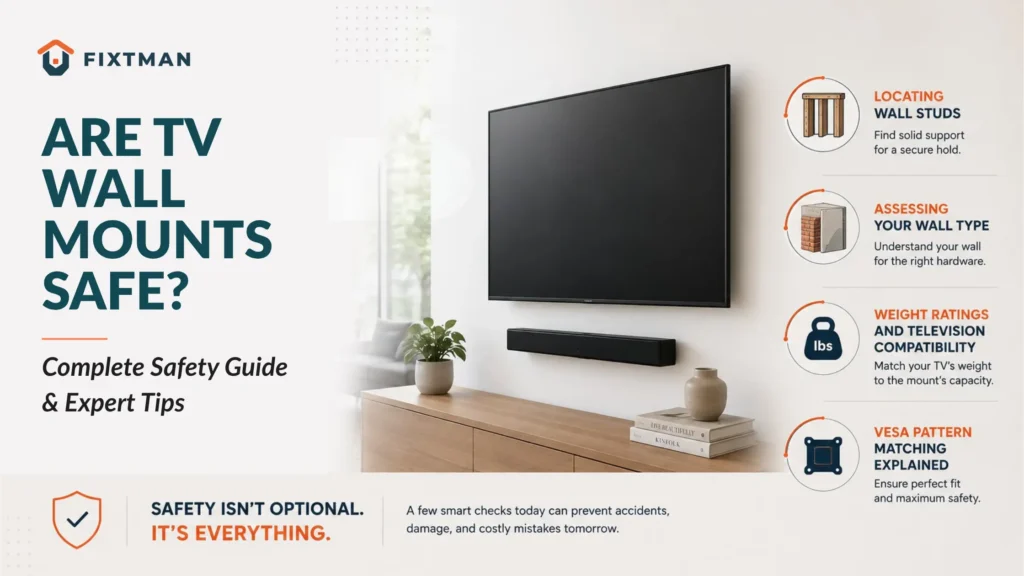

Mounting a television on the wall is one of the most popular home entertainment solutions today. But many homeowners wonder: are TV wall mounts safe? The short answer is yes—TV wall mounts are safe when properly installed, maintained, and matched to your specific television model.
Understanding the factors that determine safety helps you protect your investment and your family from potential hazards. This comprehensive guide explores everything you need to know about TV wall mount safety.
The Reality of TV Wall Mount Safety
Wall-mounted televisions create a sleek, space-saving aesthetic that appeals to modern home design. However, the safety of your installation depends entirely on how carefully you approach the mounting process. Unlike floor stands, wall mounts require precision installation into structural elements of your home.
Safety concerns about TV wall mounts are legitimate but manageable with proper knowledge and execution. The overwhelming majority of wall-mounted televisions function safely for years without incident. Problems arise primarily when people skip crucial installation steps or ignore manufacturer specifications.
Your responsibility as a homeowner is understanding these safety factors before installation begins. Taking time to learn proper procedures prevents expensive damage, injury, and potential disaster.
Common Safety Risks Associated with Wall Mounts
Several specific hazards can compromise TV wall mount safety if not addressed properly. Knowing these risks helps you implement preventative measures that keep your television and family safe.
Primary Safety Concerns:
- Bracket failure causing TV to fall from the wall
- Improper weight distribution damaging the mounting surface
- Electrical hazards from nearby outlets or connections
- Structural wall failure from inadequate anchoring
- Falls and injuries during installation or maintenance
- Cable damage creating fire or electrical risks
Understanding each risk category helps you identify which concerns apply to your specific situation. A 32-inch TV in a living room presents different challenges than a 75-inch television in a commercial setting.
Installation Factors That Determine Safety
The safety of your TV wall mount begins during installation, making this the most critical phase of the entire mounting experience. Professional installation services exist primarily because proper mounting requires technical knowledge and precision.
Critical Installation Elements:
| Factor | Importance | Impact on Safety |
| Stud Location | Essential | Provides structural support |
| Wall Type Assessment | Essential | Determines anchor compatibility |
| Mount Compatibility | Essential | Ensures proper weight distribution |
| VESA Pattern Matching | Critical | Prevents uneven stress on TV |
| Bolt Torque Specifications | Critical | Maintains secure connections |
| Cable Management | Important | Prevents electrical hazards |
| Level Installation | Important | Ensures stable positioning |
Locating Wall Studs
Wall studs are the wooden or metal vertical supports behind your drywall. These studs provide the structural integrity necessary to support your television’s weight safely. Never mount a television on drywall alone without stud backing, regardless of the mount’s weight rating.
Use a quality stud finder to accurately locate studs in your wall. Electronic stud finders are relatively inexpensive and provide reliable results. Mark each stud location with a pencil before drilling any holes.
Assessing Your Wall Type
Different wall types,drywall, plaster, concrete, brick, require different mounting approaches. Drywall demands stud backing. Concrete and brick can use expansion anchors rated for heavy loads. Plaster requires specialized anchors designed to prevent cracking.
Understanding your wall composition before beginning installation prevents mistakes that compromise safety later. If you’re uncertain about your wall type, consult with a professional installer or your home’s architectural documentation.
Weight Ratings and Television Compatibility
One of the most critical safety factors involves matching your television’s weight to your mount’s weight capacity. This straightforward principle saves lives and protects expensive equipment.
Every wall mount has a maximum weight rating clearly displayed on the packaging and manual. This rating represents the absolute heaviest television that mount can support safely. Exceeding this limit creates catastrophic failure risk.
How to Find Your TV’s Weight:
- Check the manufacturer’s specifications on the product manual
- Visit the manufacturer’s website and search your TV model
- Look for weight specifications on the original packaging
- Contact the manufacturer’s customer service directly
- Check the rating label on the back of your television
Once you know your television’s weight, verify that your chosen mount exceeds this weight by at least 25 percent. A 50-pound television requires a mount rated for at least 62.5 pounds minimum. This safety margin accounts for dynamic stresses that occur when adjusting the mount or experiencing wall vibrations.
| TV Size | Typical Weight | Recommended Mount Rating | Safety Margin |
| 32 inches | 15-25 lbs | 40+ lbs | 60% above weight |
| 43 inches | 35-45 lbs | 60+ lbs | 40% above weight |
| 55 inches | 45-60 lbs | 80+ lbs | 35% above weight |
| 65 inches | 60-75 lbs | 100+ lbs | 35% above weight |
| 75 inches | 75-90 lbs | 120+ lbs | 35% above weight |
This table provides general guidelines, but always verify your specific television’s actual weight rather than relying on size estimates. Television manufacturers use different materials and designs that affect weight significantly.
VESA Pattern Matching Explained
VESA (Video Electronics Standards Association) patterns define the mounting hole spacing on the back of your television. Matching your TV’s VESA pattern to your mount’s VESA compatibility is non-negotiable for safe installation.
Each television model has a specific VESA pattern—such as VESA 200×200 (meaning 200mm spacing horizontally and vertically between mounting holes). Your wall mount must accommodate this exact pattern or compatible patterns within safe ranges.
Why VESA Matching Matters for Safety:
Using an incompatible VESA pattern forces mounting bolts into incorrect positions, creating uneven stress distribution across the TV’s frame. This uneven stress can damage the television’s internal structure or cause the TV to slip from the bracket unexpectedly.
Always check your TV’s specifications for its VESA pattern before purchasing a mount. Many universal mounts accommodate multiple VESA patterns with adjustable brackets, making them versatile choices for homes with multiple televisions.
Professional Installation vs. DIY Mounting
The decision between professional installation and DIY mounting significantly impacts your wall mount’s safety. This choice reflects the most important decision you’ll make regarding TV wall mount safety.
Professional Installation Advantages:
- Trained technicians understand structural elements
- Specialized tools ensure accurate placement
- Insurance coverage protects against accidents
- Warranty support if problems develop
- Experience with various wall types and complications
- Proper cable concealment and management
DIY Installation Advantages:
- Cost savings for straightforward installations
- No scheduling delays or wait times
- Direct control over installation process
- Learning opportunity about your home structure
For most homeowners, professional installation makes sense for televisions 55 inches or larger. The expertise professionals bring justifies the investment, especially considering the cost of a damaged television.
Wall Damage and Structural Concerns
Before mounting any television, assess whether your wall can safely support the installation. Damaged, weakened, or poorly constructed walls cannot support television mounts reliably.
Warning Signs Your Wall Needs Reinforcement:
- Previous damage or cracks visible in drywall
- Water stains or signs of moisture problems
- Hollow sounds when tapping on walls
- Visible mold or mildew growth
- Uneven or sloping wall surfaces
- Recent structural work or renovation in the area
If you notice any of these warning signs, contact a professional before proceeding with installation. Attempting to mount a TV on compromised walls risks failure regardless of the mount quality.
Reinforcement Options
If your wall shows minor damage, reinforcement brackets can distribute weight across a larger area, reducing stress on individual mounting points. These brackets attach to studs and provide additional support for the television bracket.
Electrical Safety Considerations
Electrical safety is an important part of mounting a TV on the wall. Keep power cables at least 12 inches away from electrical outlets and use a quality surge protector to protect your TV from power surges. Avoid connecting multiple power strips together, as this can increase the risk of overheating and fire.
Check your cables regularly for signs of damage, and always use in wall rated cables if they will run inside the wall. For added protection, use GFCI outlets where recommended, as they automatically shut off power if an electrical fault is detected.
Never run power cables through walls without proper conduit and fire-rated materials. Doing so violates electrical code and creates serious fire hazards. Always use qualified electricians for any electrical work related to your TV installation.
Regular Maintenance for Ongoing Safety
Installation represents just the beginning of your responsibility for TV wall mount safety. Ongoing maintenance throughout the mount’s lifespan ensures continued safety and reliable performance.
Monthly Maintenance Tasks:
- Check all visible bolts for tightness using appropriate tools
- Inspect the mounting bracket for rust or corrosion
- Examine cables and connections for damage
- Test tilting or swivel functions if your mount offers them
- Look for any signs of wall damage around the mounting area
Annual Maintenance Tasks:
- Professional inspection for wear and tear
- Measurement verification that the TV hasn’t shifted position
- Electrical safety inspection of power connections
- Assessment of wall condition for structural integrity
- Bolt torque verification using a torque wrench
These maintenance routines sound time-consuming but typically require only 15-30 minutes total. Regular attention prevents small problems from becoming dangerous situations.
Specific Safety Concerns for Different Mount Types
Different mounting styles present unique safety considerations based on their design and functionality.
Fixed Mounts
Fixed mounts offer the most stability because they lack moving parts. Safety risks are minimal with fixed mounts if properly installed. However, the inability to adjust angles means you must get positioning correct during initial installation.
Tilting Mounts
These mounts allow vertical angle adjustment, useful for reducing glare or optimizing viewing height. The additional moving parts create more potential failure points. Ensure that tilt mechanism bolts are secure and free of debris.
Full-Motion Mounts
Also called articulating or swivel mounts, full-motion mounts provide maximum flexibility but introduce more complexity. The extended arms and multiple joints require regular inspection to ensure no connections have loosened. These mounts are best reserved for professional installation due to their complexity.
Ceiling Mounts
Suspended television installations require absolutely correct installation into structural ceiling elements. Any error in ceiling mount installation creates life-threatening hazard. Always use professional installation for ceiling-mounted televisions.
Safety Statistics and Real-World Data
Understanding actual safety data helps put TV wall mount risks into proper perspective. Statistics show that wall-mounted television injuries are relatively uncommon compared to other household accidents.
Key Safety Statistics:
- Approximately 16,000 television-related injuries occur annually in U.S. homes
- Only 5-8% of these injuries involve wall-mounted televisions
- Most injuries result from improper installation rather than mount failure
- Falls from wall mounts cause less than 1% of all television injuries
- Professional installations show 95%+ safety rating after five years
- DIY installations show 87% safety rating after five years
These statistics demonstrate that wall mounts are fundamentally safe when installed correctly. The difference between professional and DIY results highlights the importance of proper technique.
What to Do If Your Wall Mount Shows Problems
If you notice any concerning signs with your existing wall mount, take action immediately rather than waiting for problems to worsen.
Concerning Signs Requiring Immediate Attention:
- Television tilting or appearing unstable
- Visible gaps between bracket and wall
- Bolts that keep loosening despite tightening
- Creaking or stress sounds when adjusting the mount
- Wall damage appearing around mounting area
- Difficulty moving tilting or swivel functions
If you observe any of these issues, stop using the mount immediately. Remove the television carefully and inspect the mounting hardware and wall condition. Contact a professional if you cannot identify and resolve the problem yourself.
Choosing the Right Mount for Safety
Choosing a high quality TV wall mount is just as important as installing it correctly. A reliable mount should come from a trusted manufacturer, include a clear weight rating, provide detailed installation instructions, and use strong hardware such as Grade 8 bolts. It should also support multiple VESA patterns and be made from durable steel or aluminum.
Avoid very cheap wall mounts from unknown brands. They may use low quality materials and weaker hardware, increasing the risk of failure over time. Spending a little more on a trusted mount helps protect your TV and provides a safer, more secure installation.
Conclusion
Are TV wall mounts safe? Yes, when properly installed, matched to your TV’s weight, and regularly checked for security. Following the right installation and maintenance practices can help keep your TV secure and your home safe.
If you’re unsure about installing your TV yourself, Fixtman offers professional TV mounting services to ensure your TV is securely and correctly installed. With the right installation, you can enjoy the space-saving benefits of a wall-mounted TV with peace of mind.
Frequently Asked Questions
Can I mount a TV on drywall without studs?
No, never mount a TV on drywall alone. Always anchor into wall studs for structural support and safety. Drywall cannot support television weight reliably.
What weight rating should my mount have for a 55-inch TV?
A 55-inch TV typically weighs 45-60 pounds, so your mount should be rated for at least 75-80 pounds minimum for adequate safety margin.
How often should I check my TV wall mount bolts?
Check bolts monthly for tightness and conduct thorough inspection annually with professional assessment. Vibrations and temperature changes can loosen bolts over time.
Is professional installation really necessary?
Professional installation is recommended for TVs 55 inches or larger due to complexity and risk. Smaller TVs can be safely installed by homeowners with proper knowledge.
What happens if I use the wrong VESA pattern?
Using an incompatible VESA pattern creates uneven stress on the TV’s frame, potentially causing damage, tilting, or the TV slipping from the bracket unexpectedly.
Can I use drywall anchors instead of studs?
Drywall anchors have weight limits and cannot support televisions reliably. Always use studs for primary support, though anchors can supplement in some cases with professional guidance.
Is it safe to mount a TV above a fireplace?
Mounting above active fireplaces risks heat damage to electronics and creates safety hazards. Mount televisions away from heat sources unless the fireplace is decorative only.
Do I need surge protection for my wall-mounted TV?
Yes, surge protection is essential for protecting your television from electrical damage. Use quality surge protectors rated for entertainment equipment specifically.
What should I do if my TV tilts to one side on the wall mount?
Stop using the mount immediately and remove the TV carefully. This indicates installation error or structural problem requiring professional assessment and correction.
How can I prevent my children from touching a wall-mounted TV?
Mount the television high enough that children cannot reach it, use anti-tip straps, restrict access to the room, and educate children about television safety hazards.