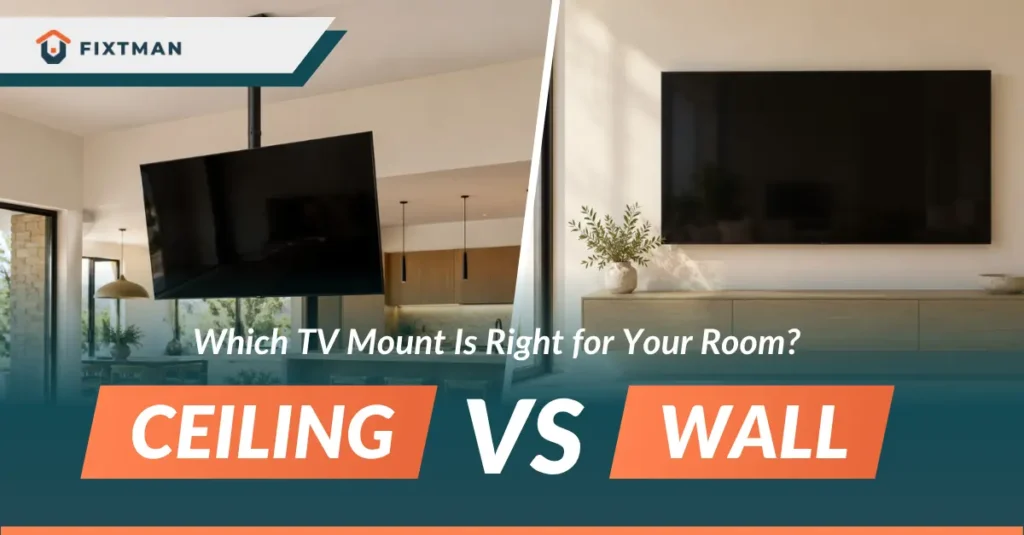

When comparing a ceiling mount vs wall mount TV, the right choice depends on your room layout, viewing position, available wall space, and installation requirements. Wall mounts are common for standard rooms, while ceiling mounts can be useful when wall space is limited or a flexible viewing position is needed.
Types of Wall Mounts
Wall mounts come in several designs to suit different viewing needs:
- Fixed mounts: Keep the TV close to the wall and work well for straightforward, front-facing viewing.
- Tilting mounts: Allow the screen to angle up or down, making them useful for higher TV installations.
- Full-motion mounts: Let you extend, swivel, and tilt the TV toward different seating positions.
Types of Ceiling Mounts
Ceiling TV mounts also come in different configurations depending on the installation and viewing requirements:
- Fixed ceiling mounts: Hold the TV in a stationary position and are suitable when the viewing direction does not need to change.
- Tilting ceiling mounts: Allow vertical angle adjustments for more comfortable viewing.
- Swivel or adjustable mounts: Let you change the TV’s direction and viewing angle.
- Drop-down mounts: Lower the TV from the ceiling and can be useful when the screen needs to be stored or positioned higher when not in use.
Benefits of a Wall Mount
Saves Floor Space
A wall mount keeps the TV off furniture and the floor, making more space available in the room. It is especially useful in smaller bedrooms, apartments, and living rooms.
Creates a Clean, Modern Look
Mounting the TV directly on the wall creates a neat, streamlined appearance. Cable management can make the installation look even more organized.
Provides Flexible Viewing Options
Depending on the mount type, you can keep the TV fixed, tilt it up or down, or adjust its position with a full-motion mount. This makes it easier to match the TV to your seating arrangement.
Works Well in Most Rooms
Wall mounts are suitable for bedrooms, living rooms, offices, and entertainment areas. As long as the wall can safely support the TV and mount, installation is usually straightforward.
Benefits of a Ceiling Mount
Saves Wall Space
A ceiling mount is useful when walls are occupied by windows, doors, cabinets, or other fixtures. It lets you install the TV without taking up valuable wall space.
Offers Flexible Viewing Angles
Many ceiling mounts allow the TV to tilt or swivel, making it easier to adjust the screen toward different seating positions. This is useful in rooms with flexible or multiple viewing areas.
Works in Unusual Room Layouts
Ceiling mounting can solve installation challenges in rooms where a traditional wall mount is impractical. It can be particularly useful in open-plan spaces, commercial areas, and rooms with limited wall space.
Keeps the TV Away From Furniture
A ceiling mount eliminates the need for a TV stand or entertainment unit. This can free up furniture space and create a cleaner, less crowded setup.
Requires a Strong Ceiling Structure
The ceiling must be capable of safely supporting the combined weight of the TV and mounting hardware. Proper anchoring and structural assessment are essential before installation.
Key Comparison Factors
When deciding between a ceiling mount vs wall mount TV, consider how each option fits your space and viewing needs.
| Factor | Wall Mount | Ceiling Mount |
| Installation | Usually simpler | More complex |
| Viewing Height | Easy to position at wall level | Often higher |
| Viewing Angle | Fixed, tilt, or full-motion options | Adjustable depending on mount |
| Wall Space | Requires suitable wall area | Saves wall space |
| Ceiling Structure | Not required | Must support the mount and TV |
| Best For | Living rooms, bedrooms, offices | Limited wall space, commercial areas, unique layouts |
| Cable Management | Usually easier | May require ceiling routing |
| Cost | Generally lower | Often higher due to installation complexity |
Pros and Cons Summary
Wall Mount Pros
- Clean, low-profile installation
- Easy access to different mount styles
- Suitable for most living rooms and bedrooms
- Generally easier to install and maintain
Wall Mount Cons
- Requires suitable wall space
- Limited flexibility with fixed models
- May not work well on unsuitable or weak walls
Ceiling Mount Pros
- Saves valuable wall space
- Useful for unusual room layouts
- Can provide flexible viewing angles
- Works where wall mounting is impractical
Ceiling Mount Cons
- More complicated installation
- Requires a suitable ceiling structure
- Cable routing can be more challenging
- Professional installation may cost more
Considerations Before You Choose
Check Your TV’s Size and Weight
Make sure the mount is rated for your TV’s screen size and weight. The mount should comfortably support the TV rather than being selected at the edge of its weight limit.
Confirm the VESA Pattern
Check the VESA mounting pattern on the back of your TV before buying a mount. The mount must support the same hole pattern to attach securely.
Assess the Wall or Ceiling Structure
For a wall mount, check the wall material and stud placement. For a ceiling mount, make sure the ceiling structure and mounting point can safely support the TV and bracket.
Think About Viewing Height and Angle
Consider where you will sit and how high the TV will be positioned. If a ceiling mount places the TV higher, choose a model with suitable tilt or swivel adjustment for comfortable viewing.
Plan Cable Management
Think about how power and other cables will reach the TV before installation. Wall-mounted cables are often easier to route, while ceiling installations may require additional planning.
Conclusion
The choice between a ceiling mount vs wall mount TV comes down to your room’s structure and viewing requirements. A wall mount is generally practical for standard rooms, while a ceiling mount can solve installation challenges where wall space is limited or a different viewing position is needed.
For a secure installation, Fixtman can help you choose and install the appropriate TV mount based on your TV, wall or ceiling structure, and room layout. Professional technicians use the proper tools and installation methods to help ensure the TV is securely mounted.

Frequently Asked Questions
Is a Ceiling Mount More Expensive Than a Wall Mount?
A ceiling mount can cost more because installation may require additional hardware, structural assessment, and more complicated cable routing.
Can Every Ceiling Support a TV Mount?
No. The ceiling must have a suitable structure capable of supporting the TV and mounting hardware. A professional should check the mounting point before installation, particularly with heavier TVs or unusual ceiling constructions.
Which Option Is Better for Small Apartments?
A wall mount is often practical when a suitable wall is available because it keeps the TV close to the wall without occupying floor space. A ceiling mount may be useful when wall space is limited or the room layout makes wall mounting difficult.
Can Fixtman Install Both Wall and Ceiling TV Mounts?
Yes, Fixtman can provide professional TV mounting services for different installation requirements, including wall and ceiling mounting. Technicians can assess the installation area, use appropriate equipment, and securely install the TV.
How Much Does Professional TV Mount Installation Cost?
Professional TV mounting costs vary depending on the TV size, mount type, wall or ceiling material, installation height, and cable management requirements. Ceiling installations may require additional labor or hardware compared with standard wall mounting.