Mounting a TV at the right height makes all the difference in your viewing experience, so how high should a TV be mounted is an important question to answer before you begin. Too high and you’ll strain your neck constantly during your favorite shows. Too low and you’ll spend hours with an uncomfortable posture that leaves your neck sore by bedtime.
Getting the mounting height correct from the start saves you from the hassle of remounting later. This comprehensive guide will walk you through calculating the perfect height for any room and TV size. Fixtman helps thousands of homeowners get this right, and now we’ll share exactly how to do it.
What Is the Ideal Height to Mount a TV?
The general rule for TV mounting is to place the center of your screen at eye level when seated. This means the middle of your TV should align with your eyes when you’re relaxing and viewing. Most experts agree this creates the most comfortable and natural viewing angle for extended periods.
However, “eye level” varies depending on your seating position and room setup. The average eye level for someone sitting on a standard couch is between 42 and 48 inches from the floor. This measurement becomes your baseline for calculating the perfect mounting height for your specific situation.
For most living rooms, mount the TV so the center of the screen is about 40–48 inches (100–122 cm) above the floor, with the viewing angle ideally kept within 10–15° above eye level to reduce neck strain.
Why Proper Television Height Matters
Viewing Comfort and Posture
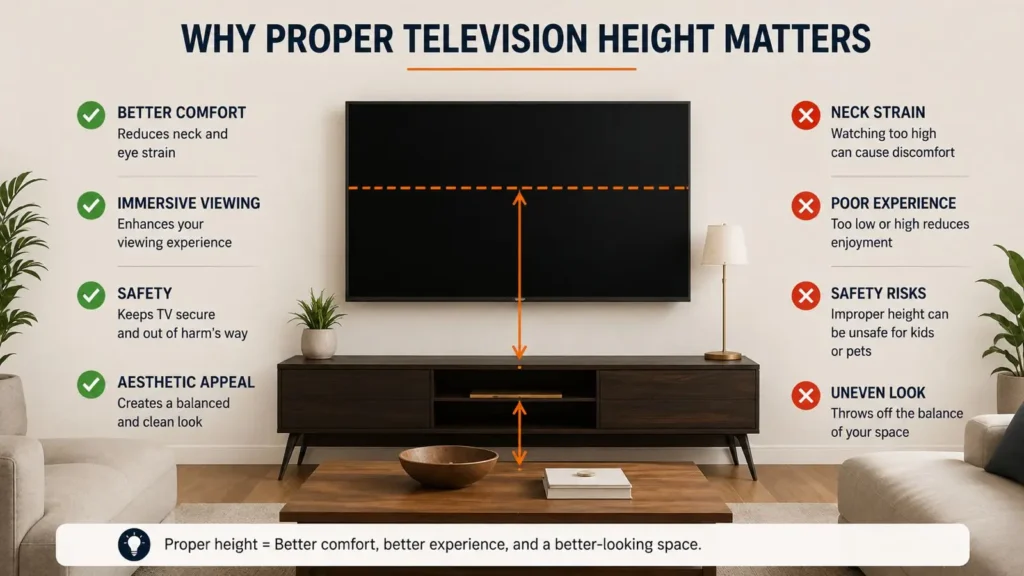
A properly mounted television supports natural posture. When the screen is aligned with your seated eye level, your neck and shoulders remain relaxed. If the television is mounted too high or too low, your body compensates by adjusting posture, which can lead to discomfort during long viewing sessions.
Clearer Image and Better Viewing Angles
Television screens are designed to deliver optimal brightness and color when viewed from specific angles. When mounted correctly, you see the image as intended. Poor placement can create glare, reduce clarity, or distort color contrast.
Balanced Room Design
A well-positioned television integrates naturally into the room’s layout. It aligns visually with furniture, wall décor, and seating arrangements, creating a more harmonious and organized appearance.
Safety and Structural Stability
Correct placement reduces the risk of accidental bumps, strain on mounting brackets, or uneven weight distribution. Proper positioning also ensures that cables and connections remain secure and accessible.
How Do You Calculate the Perfect TV Mounting Height?
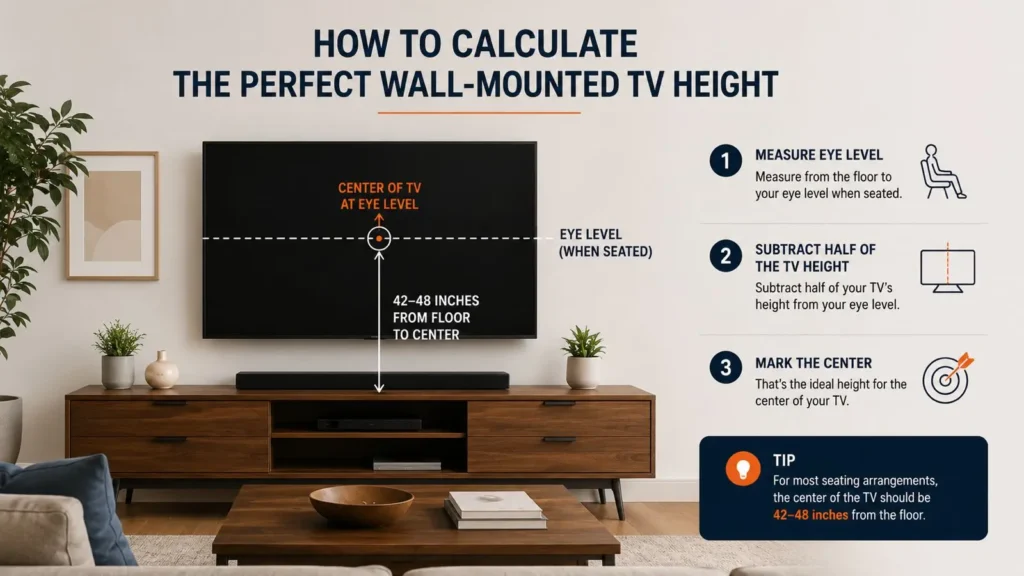
Calculating your TV mounting height requires just a few measurements and some simple math. Start by measuring the height of your seating surface from the floor.
- A typical couch seat height is around 17 to 19 inches from the ground.
- Next, measure the vertical distance from your seat to your eye level. Most people’s eyes sit about 24 to 28 inches above where they sit down.
- Add these two measurements together to find your eye level height when seated.
- Once you know your eye level height, subtract half the TV’s screen height. This places the center of your TV at your comfortable viewing level.
| Calculation Steps | Example |
| Measure seat height | 18 inches |
| Add eye level height above seat | 24 inches |
| Total eye level | 42 inches |
| Subtract half TV screen height (55″) | 15 inches |
| Final mounting center height | 27 inches |
How High Should Different TV Sizes Be Mounted?
Each TV size has different dimensions that affect mounting height calculations. Understanding your specific TV’s measurements is crucial for getting the height just right. Here’s a breakdown of standard mounting heights for popular TV sizes.
How High Should a 43-Inch TV Be Mounted?
A 43-inch TV typically has a screen height of about 24 inches. For the center of the screen to be at the standard 42-inch eye level, mount the TV bracket at approximately 30 inches from the floor. This positioning works well for most living rooms with standard seating arrangements.
How High Should a 50-Inch TV Be Mounted?
A 50-inch TV has a screen height of roughly 28 inches. To achieve center-eye-level viewing, position the mount bracket at about 28 inches from the floor. This height provides comfortable viewing without strain for seated viewers.
How High Should a 55-Inch TV Be Mounted?
The 55-inch size is one of the most popular TV sizes in American homes today. These screens are typically 31 inches tall, making an ideal mounting height of approximately 26 inches from the floor. This creates that perfect eye-level viewing experience for your living room.
How High Should a 65-Inch TV Be Mounted?
A 65-inch TV measures roughly 36 inches in height, requiring a lower mounting position than smaller screens. Mount the center of your TV at approximately 24 inches from the floor for optimal eye-level viewing. This positioning ensures comfort even during long movie marathons.
How High Should a 75-Inch or 77-Inch TV Be Mounted?
Large-screen TVs like 75 and 77-inch models stand about 43 inches tall. These massive screens should be mounted with the center at approximately 22 inches from the floor. The height difference is significant compared to smaller TVs because of the screen’s greater vertical span.
How High Should an 85-Inch TV Be Mounted?
An 85-inch TV is exceptionally large, standing about 48 inches in height. Mount the center of your screen at approximately 18 inches from the floor to maintain comfortable eye-level viewing. This ultra-high mounting position works best in spacious rooms with generous seating distances.
Does the Ideal TV Mounting Height Change by Room?
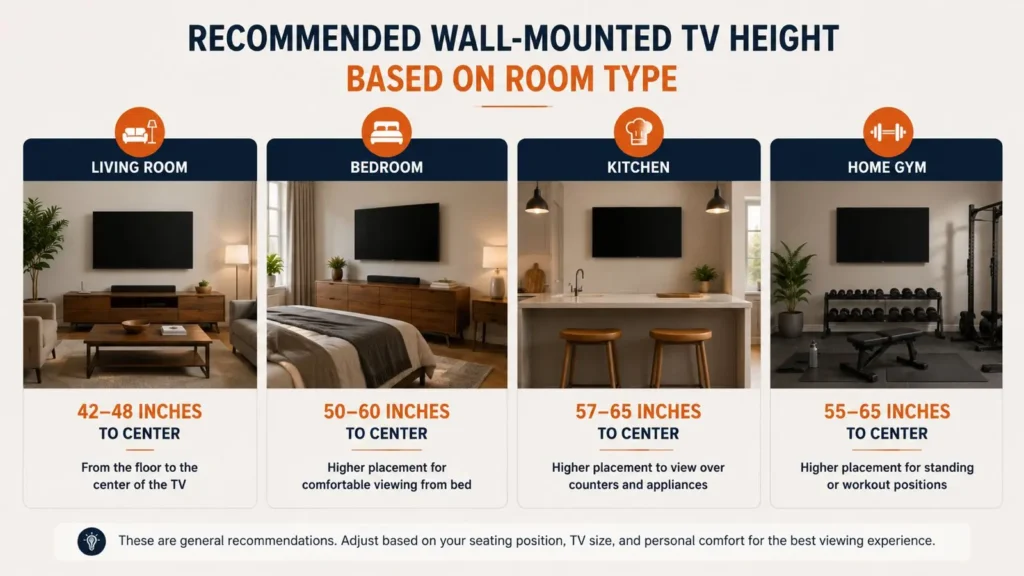
Different rooms have different viewing distances and seating arrangements that affect ideal mounting height. Your living room layout differs significantly from your bedroom setup. Understanding these room-specific factors helps you choose the perfect height for each space.
What Is the Best TV Mounting Height for a Living Room?
Living rooms typically have the longest viewing distances in a home. Most people sit 8 to 12 feet away from their TV in this space. The standard 42 to 48-inch eye-level mounting height works perfectly for living room viewing.
Living room seating is usually multiple people on a standard couch setup. This encourages mounting at the traditional eye level to accommodate various viewer heights. The extra distance means your TV needs to be proportionately sized for comfortable viewing.
Should You Mount a TV Higher in the Bedroom?
Bedroom viewing is fundamentally different from living room entertainment. Most people watch bedroom TVs while lying in bed, not sitting upright. This changes the optimal viewing angle significantly from standing eye level.
For bedroom mounting, you might need to mount the TV 5 to 10 inches higher than the traditional calculation. When lying down, your eyes naturally look upward, so a higher mounting position reduces neck strain. A tilting mount works great in bedrooms to angle the screen downward toward your viewing position.
What Is the Right TV Height for a Home Theater or Media Room?
Home theaters are dedicated viewing spaces where comfort is paramount. These rooms often have theater-style seating with recliners rather than standard couches. Reclining positions require the TV to be mounted slightly higher than typical living room heights.
In dedicated home theaters, aim for a 50-inch eye-level height rather than the standard 42 inches. This accommodates the reclined seating position and provides optimal neck angles. The result is theatrical-level comfort for marathon viewing sessions.
How High Should a TV Be Mounted in a Home Office or Gaming Room?
Office and gaming setups require different mounting considerations than entertainment spaces. You’re usually seated at a desk or gaming chair, both of which have different heights than a living room couch. Office chairs often sit higher, typically 18 to 20 inches above floor level.
Gaming chairs and office seating might bring your eye level to 48 to 52 inches from the floor naturally. Mount your TV center at these higher points to maintain comfortable viewing angles during work or gaming sessions. Many office spaces benefit from tilting or articulating mounts for adjustable viewing angles.
Should You Mount a TV Above a Fireplace?
Mounting a TV above a fireplace is a popular design choice in many homes. However, this placement presents unique mounting height challenges that differ from standard wall mounting. The heat and sightlines must be carefully considered.
If you must mount above a fireplace, use a tilting mount to angle the screen downward. This compensates for the excessive height and improves viewing comfort significantly. A tilting mount can reduce neck strain from an otherwise-too-high TV by 30 to 40 percent.
| Mounting Location | Standard Eye Level | Typical Adjustment | Best Mount Type |
| Standard Wall | 42-48 inches | No adjustment needed | Fixed or tilting |
| Above Fireplace | 50-60 inches | Tilt down 15-20 degrees | Tilting or articulating |
| Bedroom Wall | 42-48 inches | Raise 5-10 inches | Tilting preferred |
| Gaming/Office | 48-52 inches | Varies by chair | Articulating |
What Is the Best Viewing Distance for Your TV Size?
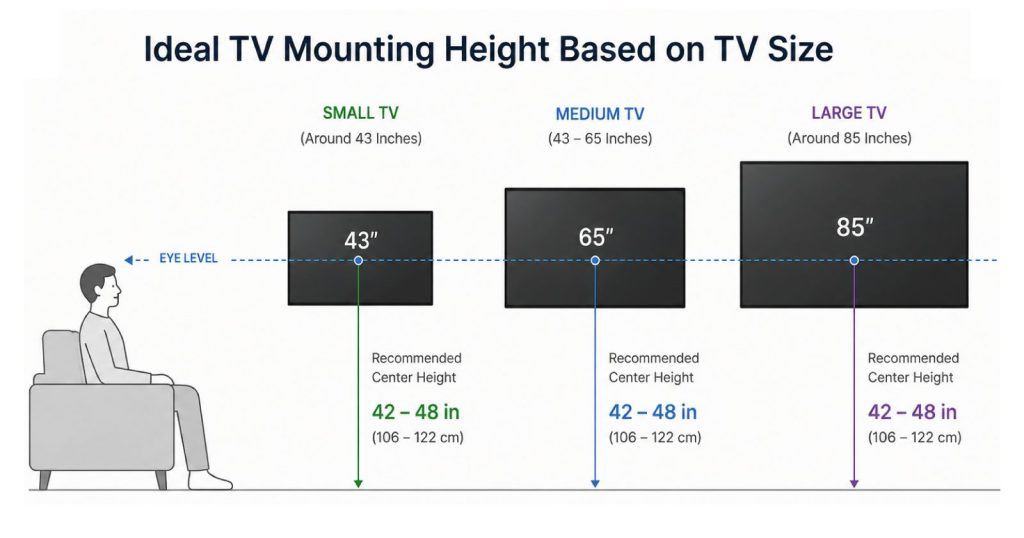
The distance between your seating and TV significantly impacts the optimal mounting height. Closer viewing distances require different positioning than distant viewing arrangements. Understanding this relationship helps you choose both size and height correctly.
| TV Size | Ideal Viewing Distance | Mounting Height | Comfort Rating |
| 43-50 inches | 5-8 feet | 28-30 inches | Excellent |
| 55 inches | 7-9 feet | 26 inches | Excellent |
| 65 inches | 8-11 feet | 24 inches | Very Good |
| 75+ inches | 10-15+ feet | 18-22 inches | Very Good |
Which Type of TV Wall Mount Is Best for Your Setup?
Different mount types offer different flexibility for achieving ideal viewing heights. Your choice of mount affects how well you can optimize your specific mounting height. Understanding each type helps you make the best decision for your room.
Fixed mounts
Fixed mounts keep your TV flush against the wall with no movement capability. These are simplest to install and most affordable, but offer no height adjustment once mounted. If you calculate your height correctly initially, a fixed mount works perfectly and looks clean and modern.
Tilting mount
Tilting mounts allow you to tilt the screen up and down by 15 to 20 degrees. This flexibility lets you adjust viewing angles even if your initial mounting height isn’t perfect. Tilting mounts work great for fireplaces or bedrooms where height compromises might be necessary.
Articulating or full-motion mounts
Articulating or full-motion mounts provide maximum flexibility with arms that extend and swivel. These mounts let you pull the TV away from the wall or angle it in multiple directions. Full-motion mounts are ideal for spaces where viewing positions vary significantly throughout the room.
What Are the Most Common TV Mounting Mistakes to Avoid?
Many people make preventable mistakes when mounting TVs that create discomfort or damage. Learning from common errors helps you get it right the first time.
Mounting the TV Too High
The biggest mistake is mounting the TV too high for the viewing distance. This forces viewers to look up constantly, causing neck strain and headaches.
Ignoring Different Seating Positions
Another common error is ignoring seating position variations in your room. If different people sit at different heights or distances, pick a compromise height that works for most viewers.
Choosing the Wrong TV Mount
Not using a mount type that suits your space is another frequent mistake. Mounting a fixed bracket in a room with multiple viewing angles can lead to poor sightlines from some seats. Choosing a tilting or articulating mount in these situations provides much better flexibility.
Failing to Account for Obstructions
Some people mount the TV without accounting for furniture or other obstacles blocking the view. Always check that nothing obstructs sightlines from your main seating position. A beautiful wall mount becomes useless if a lamp, shelf, or piece of furniture blocks the screen.
TV Mount Types: Which One Fits Your Wall?
Getting the height right is only half the job — the mount type you pick decides how much room you have to adjust later. Here’s a quick breakdown of your options:
| Mount Type | Best For | Flexibility |
|---|---|---|
| Fixed | One seating spot, straightforward wall | None — must be exact before drilling |
| Tilting | Fireplaces, bedrooms, high walls | Angles 10–15° down to correct height mistakes |
| Swivel | Open-concept rooms, kitchens | Turns side to side, not up/down |
| Full-Motion | Sectionals, shared or multi-use rooms | Extends, tilts, and swivels — most forgiving |
When Should You Hire a Professional TV Mounting Service?
Professional mounting ensures your TV is at the perfect height while saving time and preventing costly mistakes. Fixtman makes installation easy and safe, especially for large or heavy TVs.
High or difficult-to-reach locations also require expert help. If you’re unsure about the right height or room layout, Fixtman can recommend the best setup for your space.

Conclusion
Mounting your TV at the correct height transforms your viewing experience from uncomfortable to absolutely perfect. The standard eye-level recommendation of 42 to 48 inches works for most situations, but your specific room and seating arrangement might require adjustments. Taking time to calculate your ideal height prevents future regrets and neck strain.
Whether you choose to tackle this project yourself or hire Fixtman for professional installation, getting it right matters. We’re here to help with expert guidance, precise calculations, and professional mounting services. Contact Fixtman today to mount your TV at the ideal height for your home and enjoy years of comfortable, strain-free viewing.
Frequently Asked Questions
1. Should a TV Be Mounted at Eye Level?
Yes, mounting your TV with the center at eye level when seated is the standard recommendation for most comfortable viewing.
2. Can a TV Be Mounted Too High?
Absolutely, mounting too high forces constant upward neck strain and discomfort during viewing, which becomes painful over time.
3. How Do You Know if Your TV Is Mounted Too High?
If you find yourself constantly looking up, experience neck strain after short viewing periods, or notice your eyes getting tired, your TV is mounted too high.
4. Does a Tilting TV Mount Change the Recommended Mounting Height?
Yes, a tilting mount lets you compensate for height variations by angling the screen downward for more comfortable viewing angles.
5. Should the Bottom or Center of the TV Be at Eye Level?
The center of the TV screen should align with your eye level, this positioning minimizes neck strain during extended viewing sessions.
6. How High Should a TV Be Mounted if You Watch While Reclining?
For reclining viewers, mount the TV 5 to 10 inches higher than standard eye-level height to account for the upward viewing angle.
7. What If Your Seating Distance Is Longer Than Recommended?
If you sit farther than recommended, you might mount slightly higher, but maintain the center-at-eye-level principle as your primary guideline.
8. Is There a Difference in Mounting Height for Curved TVs?
No, curved TVs use the same mounting height calculations as flat screens based on screen size and eye-level positioning.
9. How Do You Adjust Mounting Height if You Have Multiple Viewing Heights in Your Room?
Choose a compromise height that works for most viewers, or install an articulating mount that allows multiple viewing angles from different positions.
10. Should You Mount Your TV Higher if You Have High Ceilings?
High ceilings don’t change the ideal mounting height. Base calculations on your actual seating position and eye level, not ceiling height.